For anyone interested in spirituality (especially the Hindu and Buddhist varieties), in 'spiritual light' literature ("spirit-light-lit"?), or even (gasp, dare we say it) mainstream hip lit, we hear a lot about karma, karmic destiny, karmic cleansing, karma this and karma that...
Most of the reading and thinking I have seen on karma has been something like if you had your karmic act together in the past you get a better karmic deal in the present and future... or something to that effect. My very personal theory, it is personal at least because I have never seen it expounded elsewhere, is that karma works backwards as to how most of us understand it.
Let me explain.
But before I do, I would like to make an admission, according to this theory, I am most probably a karmic wimp! And the bad news is that most of you who are reading this are in the same situation, as are most of the people you know...
Basically my idea is this. If we believe in reincarnation, which is more or less a prerequisite for believing in karma, we probably also believe that we have something to learn in our lifetime(s) here on Earth. So my thinking is quite simple in this regard, learning is positively correlated with challenges, i.e. the more difficult the material and existential details of our lives the more we learn. Which also means that the opposite probably holds true. So for those of us, like me, who were born in houses with rooms, heat, electricity, running water, a full fridge, car pools, after school activities that don't involve survival, probably have thinner karmic skins than those who were born without... Or to say it differently yet again, Maslow's pyramid is a karmic map, it's just upside down.
Furthermore, many traditions who believe in karma also believe that we choose the conditions of our birth, including material comfort, existential challenges, who our parents are, geography, etc. And since we are here to learn (and/or to remember our divinity, which we could semantically or philosophically argue is quite similar), my intuition is that we learn a lot more about humanity, divinity, grace in the face of difficulty, generosity and love when life is short, difficult and very little can be taken for granted. Granted, some lessons are probably easier or more difficult to learn depending on circumstance, but it just feels like spiritual learning must be accelerated when comfort is not part of the equation...
Personally, I don't know if I would last long in an existence that many denizens of the third-world must face daily and just don't know how much humanity would shine through. I have a hard enough time expressing my humanity in my cushy little existence.
Maybe this approach to karma helps explain why the Psalmist announced that "the meek shall inherit the earth; and shall delight themselves in the abundance of peace."
If anyone knows about someone who has written about this or attempted to explain it differently, please let me know.
Any other thoughts/comments/ideas?
Friday, July 10, 2009


Friday, July 3, 2009
[Notes on] I-Ching (the Book of Changes)
A good friend recently gave me a copy of the I-Ching, also called the Book of Changes or Zhouyi. Apparently it is not that easy to attribute the date of the origin of I-Ching, which has probably been modified over the ages, but the debate goes from approximately 3000 years BCE to 300 years BCE, with recent research preferring 9th century BCE. Regardless of the date and the person/s behind the I-Ching, in any case it has been around for quite some time and has had quite an influence on Chinese and Asian philosophy and thinking.
According to wikipedia, "The text describes an ancient system of cosmology and philosophy that is intrinsic to ancient Chinese cultural beliefs. The cosmology centres on the ideas of the dynamic balance of opposites, the evolution of events as a process, and acceptance of the inevitability of change."
I have now been trying it out for a couple of days and it does seem interesting. While I am only discovering the book and its wisdom, my early impressions is that it feels like an intelligent daily horoscope which not only guides you but also makes you think and ponder over personal issues. Kind of like an active meditation (meditation in the sense contemplating or turning something over in one's mind). Interesting in any case and I look forward to discovering more about it.
I won't even try to explain what it is for those who are not familiar with it but once again allow Wikipedia's anonymous authors to attempt an explanation:

Basically, to use the I-Ching the 8 trigrams are organized in an 8 by 8 matrix and there is a simple method to find the appropriate square on the I-Ching 'checkerboard' (my personal expression).
Anyway, I have the Brian Browne Walker translation. If anyone has a good book to recommend so that I can learn more on the subject please let me know.
According to wikipedia, "The text describes an ancient system of cosmology and philosophy that is intrinsic to ancient Chinese cultural beliefs. The cosmology centres on the ideas of the dynamic balance of opposites, the evolution of events as a process, and acceptance of the inevitability of change."
I have now been trying it out for a couple of days and it does seem interesting. While I am only discovering the book and its wisdom, my early impressions is that it feels like an intelligent daily horoscope which not only guides you but also makes you think and ponder over personal issues. Kind of like an active meditation (meditation in the sense contemplating or turning something over in one's mind). Interesting in any case and I look forward to discovering more about it.
I won't even try to explain what it is for those who are not familiar with it but once again allow Wikipedia's anonymous authors to attempt an explanation:
The text of the I Ching is a set of oracular statements represented by a set of 64 abstract line arrangements called hexagrams. Each hexagram is a figure composed of six stacked horizontal lines, where each line is either Yang (an unbroken, or solid line), or Yin (broken, an open line with a gap in the center). With six such lines stacked from bottom to top there are 26 or 64 possible combinations, and thus 64 hexagrams represented.While that is not the easiest explanation, maybe a visual one of the trigrams could help:
The hexagram diagram is conceptually subdivided into two three-line arrangements called trigrams. There are 23, hence 8, possible trigrams. The traditional view was that the hexagrams were a later development and resulted from combining the two trigrams. However, in the earliest relevant archaeological evidence, groups of numerical symbols on many Western Zhou bronzes and a very few Shang oracle bones, such groups already usually appear in sets of six. A few have been found in sets of three numbers, but these are somewhat later. Note also that these numerical sets greatly predate the groups of broken and unbroken lines, leading modern scholars to doubt the mythical early attributions of the hexagram system.

Basically, to use the I-Ching the 8 trigrams are organized in an 8 by 8 matrix and there is a simple method to find the appropriate square on the I-Ching 'checkerboard' (my personal expression).
Anyway, I have the Brian Browne Walker translation. If anyone has a good book to recommend so that I can learn more on the subject please let me know.
Friday, June 26, 2009
In praise of non-happiness
I have written a little about this, and have talked about this quite a bit with friends, but I personally believe that depression has an important role to play in our lives and that holding up "perma-happy" as the ultimate state-of-mind to be in is a mistake modern society is increasingly making.
Periods of non-happiness, periods of mild depression, seem to be periods in which people stop to take stock of things, ask themselves important questions (even if it is to ask questions that have no real answers), reconsider things like partner, choice of career, health, diet, leisure, family and friends. Things that are not that unimportant in the grander scheme of things : )
But society is hostile to depression or any form of non-happiness basically, telling us in many shapes and forms to 'snap back', 'stop dwelling', 'buckle up', 'think positive', 'take a pill', 'get out', 'get laid', 'get a grip', 'get help', etc.
Periods of non-happiness, periods of mild depression, seem to be periods in which people stop to take stock of things, ask themselves important questions (even if it is to ask questions that have no real answers), reconsider things like partner, choice of career, health, diet, leisure, family and friends. Things that are not that unimportant in the grander scheme of things : )
But society is hostile to depression or any form of non-happiness basically, telling us in many shapes and forms to 'snap back', 'stop dwelling', 'buckle up', 'think positive', 'take a pill', 'get out', 'get laid', 'get a grip', 'get help', etc.
Recently a friend-acquaintance of mine was looking a bit down. I gave him my spiel on how I felt happiness was overrated and 'the blues' were underrated. That if he was going through a tough time that is was important, the he must be at a transition point, that it must be the right time to take stock of things and decide what is important for him and, basically, that a mild depression was not only normal but would probably turn out to be very useful. Another friend who was there reacted to my words was truly surprised to hear my words. With a lot of female intelligence, she added yes, it is normal, but pointed out that wallowing in his blues would not do much good and that asking questions without answers could put him into a dark spiral. At first, the friend in question asked us if it was really that apparent that he wasn't 'feeling 100%' and then he smiled weakly and admitted that he was trying to deal with quite a bit including the "fact" that you can't really let on to others that you aren't doing that well (especially since he works in the service industry) which is why he was trying to hide it.
While I do realize that in extreme cases depression can become severe and lead to dangerous behavior and even suicide, but I can't help to think that, except in those cases, people can be helped if we as a society except non-happiness as normal and even useful.
An interesting sidenote to all this, and the article that sparked my blog entry comes from The Economist magazine. Here is an excerpt from that article:
Depression may be linked to how willing someone is to give up his goals
CLINICAL depression is a serious ailment, but almost everyone gets mildly depressed from time to time. Randolph Nesse, a psychologist and researcher in evolutionary medicine at the University of Michigan, likens the relationship between mild and clinical depression to the one between normal and chronic pain. He sees both pain and low mood as warning mechanisms and thinks that, just as understanding chronic pain means first understanding normal pain, so understanding clinical depression means understanding mild depression.
Dr Nesse’s hypothesis is that, as pain stops you doing damaging physical things, so low mood stops you doing damaging mental ones—in particular, pursuing unreachable goals. Pursuing such goals is a waste of energy and resources. Therefore, he argues, there is likely to be an evolved mechanism that identifies certain goals as unattainable and inhibits their pursuit—and he believes that low mood is at least part of that mechanism.
It is a neat hypothesis, but is it true? A study published in this month’s issue of the Journal of Personality and Social Psychology suggests it might be. Carsten Wrosch from Concordia University in Montreal and Gregory Miller of the University of British Columbia studied depression in teenage girls. They measured the “goal adjustment capacities” of 97 girls aged 15-19 over the course of 19 months. They asked the participants questions about their ability to disengage from unattainable goals and to re-engage with new goals. They also asked about a range of symptoms associated with depression, and tracked how these changed over the course of the study.
Their conclusion was that those who experienced mild depressive symptoms could, indeed, disengage more easily from unreachable goals. That supports Dr Nesse’s hypothesis. But the new study also found a remarkable corollary: those women who could disengage from the unattainable proved less likely to suffer more serious depression in the long run.
Mild depressive symptoms can therefore be seen as a natural part of dealing with failure in young adulthood. They set in when a goal is identified as unreachable and lead to a decline in motivation. In this period of low motivation, energy is saved and new goals can be found. If this mechanism does not function properly, though, severe depression can be the consequence.
While the article deals with teenagers, I can't help to believe that something similar is going on with adults. The kind of crises people have at 30, 40, 50 and 60, in which oddly enough adults start to act a bit like adolescents, seem similar - people 'take advantage' of these so-called crises to stop and dwell on the circumstances of their lives, to reconsider dreams (if they are attainable, if they have slipped away, if it is 'now or never', if they have to be redefined or let go of, ...) and to reevaluate goals.
So the next time someone we know seems a bit down in the dumps, let's be supportive and make our own little contribution in the name of praise for the valuable and often spiritual growth that non-happiness can bring into our lives.
Friday, June 19, 2009
[Thoughts on] The Way of the Superior Man
I have been hearing and reading about Davide Deida, the author of The Way of the Superior Man: A Spiritual Guide to Mastering the Challenges of Women, Work, and Sexual Desire for some time. And I must admit to a good portion of skepticism before ordering and then reading this book. I first read something substantial about him in a spiritual magazine article, in EnlightenNext (previously What is Enlightenment?). The description did not really make me want to read the book but he just kept popping up time and again in different places - with some strongly for and others passionately against - and I decided that I needed to make up my own mind on the subject.
One of the ways I personally decide the value of a book is how much I underline (or not) the chapters I have read. Looking back through the book now I see that many passages are underlined and many others have achieved 'star status' (which means that I put an exclamation point or an asterisk next to a passage to symbolize that it is worth re-reading).
I could see how a book like this could piss of many women, feminists or egalitarians of either sex and just about everyone. But, he actually has a lot of very interesting things to say. And one of the most important things he says actually deflects most of the flak he receives as a macho pig - which is that while he talks about him and her he means whoever is playing a typically masculine or feminine role in a relationship (the masculine role can be played by the woman and vice versa).
His opinions are very clear and very 'piss or get off the pot' but many of them hit home with me. Much deeper and concentrated in terms of insights than what I considered the fluff of the Women are from Venus, Men are from Mars series. I found myself rethinking many situations with past girlfriends and understanding where I and we screwed up (mostly me though), what the source of many past frustrations actually were and how to, quite easily actually, change my behavior in the future.
His book delves into a lot more than the him-her relationship decoding/coaching and includes chapters on parenting, on the value of friends and friendships, on being true to your journey, on how not to compromise for the wrong reasons, and many other subjects which, at the end of the day I could summarize as treating the much larger subject of how to live life without regretting the life lived. A subject that is truly one that we can all relate too and that resonated with me quite a bit. Like someone tapping you on the shoulder and - sometimes gently, sometimes more aggressively - saying, "hey you, be careful, make sure you are on course, otherwise the list of regrets may be long and painful to look at..."
An example, well if you ask so kindly here it is:
The above is excerpted from a chapter entitled "Don't Get Lost in Tasks and Duties" which like many of the chapter titles are a quite clear summary of what is within the chapter. Other chapters are entitled, "Praise Her" (with a byline, I like, that begins 'The masculine grows by challenge, but the feminine grows by praise), "Don't Use your Family and your Life as an Excuse", "Live with an Open Heart Even if it Hurts", ...
I still haven't finished reading the book, and some of the later chapters are the more controversial, but I will probably relate my impressions on the rest of the book when I dig into the rest. Good stuff, but to be digested bit by small bit, like many the spiritual book.
Have a wonderful weekend,
Alon
One of the ways I personally decide the value of a book is how much I underline (or not) the chapters I have read. Looking back through the book now I see that many passages are underlined and many others have achieved 'star status' (which means that I put an exclamation point or an asterisk next to a passage to symbolize that it is worth re-reading).
I could see how a book like this could piss of many women, feminists or egalitarians of either sex and just about everyone. But, he actually has a lot of very interesting things to say. And one of the most important things he says actually deflects most of the flak he receives as a macho pig - which is that while he talks about him and her he means whoever is playing a typically masculine or feminine role in a relationship (the masculine role can be played by the woman and vice versa).
His opinions are very clear and very 'piss or get off the pot' but many of them hit home with me. Much deeper and concentrated in terms of insights than what I considered the fluff of the Women are from Venus, Men are from Mars series. I found myself rethinking many situations with past girlfriends and understanding where I and we screwed up (mostly me though), what the source of many past frustrations actually were and how to, quite easily actually, change my behavior in the future.
His book delves into a lot more than the him-her relationship decoding/coaching and includes chapters on parenting, on the value of friends and friendships, on being true to your journey, on how not to compromise for the wrong reasons, and many other subjects which, at the end of the day I could summarize as treating the much larger subject of how to live life without regretting the life lived. A subject that is truly one that we can all relate too and that resonated with me quite a bit. Like someone tapping you on the shoulder and - sometimes gently, sometimes more aggressively - saying, "hey you, be careful, make sure you are on course, otherwise the list of regrets may be long and painful to look at..."
An example, well if you ask so kindly here it is:
When you do your tasks the right way, they liberate your life energy so that you can attend to what really matters - the investigation, realization, and embodiment of true freedom. Do you even know what that means? Have you devoted yourself to finding out the deepest truth of your own existence? If, in this very moment, your tasks are not supporting your life in this way, you must drop them or change them so that they do. Otherwise, you are wasting your life.
The above is excerpted from a chapter entitled "Don't Get Lost in Tasks and Duties" which like many of the chapter titles are a quite clear summary of what is within the chapter. Other chapters are entitled, "Praise Her" (with a byline, I like, that begins 'The masculine grows by challenge, but the feminine grows by praise), "Don't Use your Family and your Life as an Excuse", "Live with an Open Heart Even if it Hurts", ...
I still haven't finished reading the book, and some of the later chapters are the more controversial, but I will probably relate my impressions on the rest of the book when I dig into the rest. Good stuff, but to be digested bit by small bit, like many the spiritual book.
Have a wonderful weekend,
Alon
Tuesday, June 9, 2009
[Notes on] Krishnamurti's As One Is
The full title of this small collection of talks (the former equivalent of today's podcast transmissions I guess) is As One Is - To Free the Mind of All Conditioning. And as a good friend recently pointed out, you don't really need to read the book once you read and understand the title...
In any case, this is definitely a key theme for Jiddu Krishnamurti (who I wrote about in a previous post) and the toughest injunction he left us: free your mind from all conditioning! To get there, it seems to me like he is asking each and every one of us to do two things - a permanent auto-psychoanalysis and meditation. The first is about trying to bring to light the different influences that may be operating on us (family, culture, religion, tradition, country, wealth, color of skin, place of birth, morals, society, peer pressure, expectations, desires, wants, needs, dogma, ideology, isms, etc. etc. etc.). Not to judge ourselves about them, but to try to understand them, not to avoid them or hide from them, just to bring them to the light and look them over so to speak.
The latter, meditation, is different (I get the impression) from the mainstream understanding of what meditation is or what it is for. I cannot profess to completely understand what he means when he says or talks about meditation, but most of all he tells us that if meditation is about taking control over the chattiness of the brain, or any other form of attempting to control, then that is not meditation and that is not helpful.
It is hard to relate here how dense his thinking is; dense in the sense that when I start to underline the hard-hitting ideas and sentences (as I am wont to do), I end up underlining almost the entire book. An example can get this point across and especially share with you the wonder that is Krishnamurti - the powerhouse spiritual thinker:
In any case, this is definitely a key theme for Jiddu Krishnamurti (who I wrote about in a previous post) and the toughest injunction he left us: free your mind from all conditioning! To get there, it seems to me like he is asking each and every one of us to do two things - a permanent auto-psychoanalysis and meditation. The first is about trying to bring to light the different influences that may be operating on us (family, culture, religion, tradition, country, wealth, color of skin, place of birth, morals, society, peer pressure, expectations, desires, wants, needs, dogma, ideology, isms, etc. etc. etc.). Not to judge ourselves about them, but to try to understand them, not to avoid them or hide from them, just to bring them to the light and look them over so to speak.
The latter, meditation, is different (I get the impression) from the mainstream understanding of what meditation is or what it is for. I cannot profess to completely understand what he means when he says or talks about meditation, but most of all he tells us that if meditation is about taking control over the chattiness of the brain, or any other form of attempting to control, then that is not meditation and that is not helpful.
It is hard to relate here how dense his thinking is; dense in the sense that when I start to underline the hard-hitting ideas and sentences (as I am wont to do), I end up underlining almost the entire book. An example can get this point across and especially share with you the wonder that is Krishnamurti - the powerhouse spiritual thinker:
To stand alone is to be uncorrupted, innocent, free of all tradition, dogma, of opinion, of what another says, and so on. Such a mind does not seek because there is nothing to seek; being free, such a mind is completely still without a want, without movement. But this state is not to be achieved; it isn't a thing that you buy through discipline; it doesn't come into being by giving up sex, or practicing a certain yoga. It comes into being only when there is understanding of the ways of the self, the 'me', which shows itself through the conscious mind in everyday activity, and also in the unconscious. What matters is to understand for oneself, not through the direction of others, the total content of consciousness, which is conditioned, which is the result of society, of religion, of various impacts, impressions, memories--to understand all that conditioning and be free of it. But there is no "how" to be free. If you ask how to be free, you are not listening.
When you read Krishnamurti you also realize, because he tells you, that the whole notion of 'spiritual progress'--so dear to East and West--is not where it's at. By seeking with an objective in mind we are not truly seeking, we are simply continuing our conditioning... He also helped me to understand the difference between aloneness (something very positive as he explains it--reread the above quote for his understanding of the concept) and loneliness...
Another quote linked to the first one, and to show you how with Krishnamurti you feel like he sees us in all our ugly and petty habits, names them, brings them to the light and challenges us to do something about, i.e. understand them, here is another short passage on listening:
Another quote linked to the first one, and to show you how with Krishnamurti you feel like he sees us in all our ugly and petty habits, names them, brings them to the light and challenges us to do something about, i.e. understand them, here is another short passage on listening:
Do you really listen, or are you interpreting what is being said in terms of your own understanding? Are you capable of listening to anybody? Or is it that in the process of listening, various thoughts, opinions, arise so that your own knowledge and experience intervene between what is being said and your comprehension of it?
Using this (his) strict definition, I don't think anyone could 'throw the first stone'...
He also has a wonderful passage on the explanation between concentration (which is narrow and excludes) and attention (which is open and includes); the latter which he defines as complete awareness without interpretation. Which I guess is true listening.
And I will finish this post, although I will continue to read and review the book for another post in the near future, on his take on meditation that I alluded to at the outset of this post. As usual, beautiful, right on and so difficult to apply:
He also has a wonderful passage on the explanation between concentration (which is narrow and excludes) and attention (which is open and includes); the latter which he defines as complete awareness without interpretation. Which I guess is true listening.
And I will finish this post, although I will continue to read and review the book for another post in the near future, on his take on meditation that I alluded to at the outset of this post. As usual, beautiful, right on and so difficult to apply:
Self-knowledge is the beginning of wisdom. Self-knowledge is not according to some psychologist, book, or philosopher but it is to know oneself as one is from moment to moment. Do you understand? To know oneself is to observe what one thinks, how one feels, not just superficially, but to be deeply aware of what is without condemnation, without judgment, without evaluation or comparison. Try it and you will see how extraordinarily difficult it is for a mind that has been trained for centuries to compare, to condemn, to judge, to evaluate, to stop that whole process and simply to observe what is; but unless this takes place, not only at the superficial level, but right through the whole content of consciousness, there can be no delving into the profundity of the mind. Please, if you are really here to understand what is being said, it is this that we are concerned with and nothing else. Our problem is not what societies you should belong to, what kind of activities you should indulge in, what books you should read, and all that superficial business, but how to free the mind from conditioning...
To be continued...
Saturday, June 6, 2009
On George Carlin and the future of nostalgia
I recently received an e-mail from a friend entitled "Life is not measured by the number of breaths we take, but the moments that take our breath away..." with some words attributed (properly?) to George Carlin.
I am not sure that it is really from him but allow me to reproduce the main gist of the message and then react to it. Here is my excerpt from the message:
I am not sure that it is really from him but allow me to reproduce the main gist of the message and then react to it. Here is my excerpt from the message:
The paradox of our time in history is that we have taller buildings but shorter tempers, wider freeways,but narrower viewpoints. We spend more, but have less, we buy more, but enjoy less. We have bigger houses and smaller families, more conveniences, but less time. We have more degrees but less sense, more knowledge, but less judgment, more experts, yet more problems, more medicine, but less wellness.
We drink too much, smoke too much, spend too recklessly, laugh too little, drive too fast, get too angry, stay up too late, get up too tired, read too little, watch TV too much, and pray too seldom.
We have multiplied our possessions, but reduced our values. We talk too much, love too seldom, and hate too often.
We've learned how to make a living, but not a life. We've added years to life not life to years. We've been all the way to the moon and back, but have trouble crossing the street to meet a new neighbor. We conquered outer space but not inner space. We've done larger things, but not better things.
We've cleaned up the air, but polluted the soul. We've conquered the atom, but not our prejudice. We write more, but learn less. We plan more, but accomplish less. We've learned to rush, but not to wait. We build more computers to hold more information, to produce more copies than ever, but we communicate less and less.
These are the times of fast foods and slow digestion, big men and small character, steep profits and shallow relationships. These are the days of two incomes but more divorce, fancier houses, but broken homes. These are days of quick trips, disposable diapers, throwaway morality, one night stands, overweight bodies, and pills that do everything from cheer, to quiet, to kill.
So, well, overall it is cute and makes some valid points, but in a nutshell I don't buy into it!
It seems every generation has nostalgia for the good old days, and we are just another generation with another case of 'where-did-the-good-times-go' blues... when things were better, simpler, more wholesome, cheaper, of better quality, realer, whatever, etc. etc. etc.
It seems every generation has nostalgia for the good old days, and we are just another generation with another case of 'where-did-the-good-times-go' blues... when things were better, simpler, more wholesome, cheaper, of better quality, realer, whatever, etc. etc. etc.
Come on! We have it soooo good but we don't want to admit it. Now I realize that anyone who is reading this is part of the estimated (but not by me) 1% of the world's population who has it good but even if there are lots of things we all would change about the way things are going, we also have a lot more to be thankful for today than ever before. Or at least that is the way I would like to see it, my illusion so to speak.
For anyone growing up in the States, we were enticed regularly to finish our plates because "think of all the starving kids in China"... I don't think any parents are using that line anymore. Moreover, the rising tide of China's economy is now also lifting Vietnam and starting to spillover to the economies of countries like Laos and Cambodia (along the lines of Kennedy's aphorism "a rising tide lifts all boats").
Progress in health means added years of living, even for people who are diagnosed with diseases that used to mean short-term death sentences. Those extra years, in those situations, are priceless. Personally, chemotherapy and other modern developments allowed my dad to add 10 months to his life after having been told that he only had one to live. Those extra months, while difficult, allowed him to be present at his daughter's wedding, spend quality time with the family, etc. And thanks to progress in modern medicine, and pain management, the dying process was a lot less painful than it would otherwise have been - for him and for us.
While some people do watch TV more than read, for many of the people I know this is simple not true, sorry George. Spirituality, depth, caring, giving, volunteering, spontaneous acts of kindness are there every day, at all times, if we just care to notice them more than what the news shows us about conflict and war and expressoins of violence and hatred. We don't need to turn a blind eye to the negative aspects but should learn to see the positive more often.
Any time there is a catastrophe somewhere in the world, people from all over the world send money, food, aid or themselves to help. Spontaneously. When the Tsunami hit, the outpouring of aid from all over the world that the aid agencies and NGOs received more money than they knew what to do with. Not from governments but from people like you and me.
I guess it all goes back to our original decisions about life - is it a positive or negative experience? is man inherently good or evil? is the universe inherently loving or not? If you see a loving universe then its development can only be more loving... which means that if we give it a little thought, optimism about the future should replace our illusory, i.e. the future of nostalgia should not be so bright...
Tuesday, May 19, 2009
[My Stroke of Insight] Yet more left-hemisphere thoughts on the left-right dichotomy
I have had some very interesting feedback from different friends, readers and my mom on the subject of the left-right hemispheres of the brain. And as I need to do a few papers on the Human Brain for my doctorate, my reading about all this is getting deeper (or at least wider).
Synchronistically, my mother spoke to me about an incredible woman and her story of left-brain stroke and the incredible euphoria she experienced for the several weeks that her left brain was out of service. Apparently she almost regretted getting her left-brain back and describes living with only the right hemisphere active as a kind of nirvana, a growing sense of peace that sounds much like the nirvana described by the Enlightened who have attempted to describe the undescribable in left-brain language (nirvana being, as we now know, a right-brained 'phenomenon'). Interesting (dare I say cute) sidenote, the woman remembered experiencing a feeling of being enveloped by perfect love while she lay in her hospital bed. Only after she wrote about this did her own mother tell her that while she was recovering but unable to recognize anyone, she would lie in her hospital bed next to her and hug her for hours...
The synchronicity I mention comes from another friend (you know who you are) who sent me a similar description the next day with a link to the following article on Jill Bolte Taylor, the woman my mother was telling me about (although she could not remember her name). Cool coincidence in any case. Anyhoo, said friend, also sent me this excerpt from JBT's book, My Stroke of Insight, which kind of brings home the subject of the last three post entries quite well while explaining our need for the left brains 'chatter' to function in this world:
My further thinking on this is that it doesn't seem elegant to me that we should be searching to neutralize the left brain and its chatter to achieve true and lasting 'nirvana', joy, bliss, whatever (and I doubt we would want to always be there even if we could). Based on what we know of the Universe, it would seem to make more sense that we need to find a way to dissipate the duality of the two hemispheres and allow the left to keep us grounded and allow the right to allow us to feel higher emotions, i.e. find a synthesis of the two rather than a promotion of the one over the other. Unity (or advaita (non-duality)) rather than duality... where have I heard that spiritual theme before???
Synchronistically, my mother spoke to me about an incredible woman and her story of left-brain stroke and the incredible euphoria she experienced for the several weeks that her left brain was out of service. Apparently she almost regretted getting her left-brain back and describes living with only the right hemisphere active as a kind of nirvana, a growing sense of peace that sounds much like the nirvana described by the Enlightened who have attempted to describe the undescribable in left-brain language (nirvana being, as we now know, a right-brained 'phenomenon'). Interesting (dare I say cute) sidenote, the woman remembered experiencing a feeling of being enveloped by perfect love while she lay in her hospital bed. Only after she wrote about this did her own mother tell her that while she was recovering but unable to recognize anyone, she would lie in her hospital bed next to her and hug her for hours...
The synchronicity I mention comes from another friend (you know who you are) who sent me a similar description the next day with a link to the following article on Jill Bolte Taylor, the woman my mother was telling me about (although she could not remember her name). Cool coincidence in any case. Anyhoo, said friend, also sent me this excerpt from JBT's book, My Stroke of Insight, which kind of brings home the subject of the last three post entries quite well while explaining our need for the left brains 'chatter' to function in this world:
Together with the following quote, this time from the above-mentioned article, Ms. Taylor describes the feeling as she was having the stroke:One of the jobs of our left hemisphere language centers is to define our self by saying “I am.” Through the use of brain chatter, your brain repeats over and over again the details of your life so you can remember them. It is the home of the ego center, which provides you with an internal awareness of what your name is, what your credentials are, and where you live. Without these cells performing their job, you would forget who you are and lose track of your life and your identity.
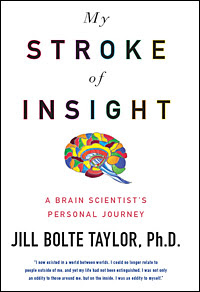
As the language centers in my left hemisphere grew increasingly silent, my consciousness soared into an all-knowingness, a "being at one" with the universe, if you will. In a compelling sort of way, it felt like the good road home and I liked it.Pretty incredible!
My further thinking on this is that it doesn't seem elegant to me that we should be searching to neutralize the left brain and its chatter to achieve true and lasting 'nirvana', joy, bliss, whatever (and I doubt we would want to always be there even if we could). Based on what we know of the Universe, it would seem to make more sense that we need to find a way to dissipate the duality of the two hemispheres and allow the left to keep us grounded and allow the right to allow us to feel higher emotions, i.e. find a synthesis of the two rather than a promotion of the one over the other. Unity (or advaita (non-duality)) rather than duality... where have I heard that spiritual theme before???
Friday, May 8, 2009
More thoughts on the left-right brain dichotomy
Well, I keep on thinking on the difference between the left and right hemispheres of the brain and the implications it has in spirituality, in observation, in regards to ego, in regards to understanding things and I find it all quite fascinating.
In all of the power of now literature, whether it be by Eckhart Tolle or anyone else, there is always this injunction to be in the now. One example that is often given is the awe we experience when faced with a wondrous landscape that nature offers us. Staying with that feeling of awe is usually held up as an example of "being in the now" which is the ultimate spiritual objective (if you buy into the literature, but also because it does feel good to be in that zone/feeling/state of mind...). So when does it all go to bits this wonderful feeling of being one with nature, the universe and everything? When you name it. That is, when you start to 'speak', even without words, when you describe it, when you say to yourself or someone 'it is so beautiful'... But putting this into the perspective of my last blog post, it is all really, and simply, a question of the left hemisphere speaking up to interrupt the blissful observation of the right hemisphere. Like the left is talking to the right while the latter is saying 'shut up will ya, I'm trying to watch'...
Actually, I had an idea about left-right that maybe in the Bible, in Genesis, there would be a mention of Adam observing first and naming all of the animals later but it was a dead end. However, if you will allow me the digression, I found it funny to reread the passage where God asks Adam, did you eat of the fruit of the tree of knowledge of good and evil? And Adam says, well yeah, but it's the woman you gave me who incited me to nibble. And then the woman says, well yeah, but it was the snake who incited me to eat it. Unfortunately for the snake he had no one to pass the blame along to and ended up legless and destined to slither forever in the dust. Very childish behavior on the part of our uber-parents, very 'it wasn't me' or 'he started it'...
Anyway, back to the Power of Now, which I just reached for following paragraph one's mention of it and here are a few nuggets that I found that I want to share with you.
The first is a basic premise of the book (a worldwide bestseller - assuming that counts as a positive), or rather of the author, is that "not to be able to stop thinking is a dreadful affliction..." (page 14 of the paperback edition), pointing out that Descartes' famous quip "I think, therefore I am" had it all wrong. For Tolle, to "equate thinking with Being and identity with thinking" is a major error - "the most basic error". Bringing in the left-right argument again, allows us to rethink the 'problem' a bit, for example, understanding that there is more to the mind than the chattiness that goes on in, and is the result of, our left hemisphere.
Later in the book (page 41) Tolle admonishes us (in the face of pain or beauty or whatever) "don't let the feeling turn into thinking". Once again, using the two hemisphere framework, it seems like we need to remain in observation with the right hemisphere (the silent brain that perceives but does not speak) and not allow the left hemisphere to start naming and rationalizing (or to re-use the metaphor, talking in the middle of the film that we are watching).
Being in the now, in a state of timelessness, is something that Tolle suggests we do (more often). And it is one of the characteristics of the right brain, while the left hemisphere counts, checks the watch, wonders how much time has gone by, etc. It really makes me think that the Zen (or Zen Buddhist) paradigm is about being 'right-minded', but literally! While I still don't know how to do that, it does make it a bit more easy to understand the 'requirements' and/or approach...
To finish this post, I want to share with you a wonderful little vignette that Watzlawick quotes in the book that got me going on this whole left-right theme, The Language of Change. It has nothing to do with anything, and I think he knew that too when he put it in his book, like I'm doing with this blog, but it is a great parable by Chuang Tzu that should help us all in 'anger management' when 'stuff' happens...
In all of the power of now literature, whether it be by Eckhart Tolle or anyone else, there is always this injunction to be in the now. One example that is often given is the awe we experience when faced with a wondrous landscape that nature offers us. Staying with that feeling of awe is usually held up as an example of "being in the now" which is the ultimate spiritual objective (if you buy into the literature, but also because it does feel good to be in that zone/feeling/state of mind...). So when does it all go to bits this wonderful feeling of being one with nature, the universe and everything? When you name it. That is, when you start to 'speak', even without words, when you describe it, when you say to yourself or someone 'it is so beautiful'... But putting this into the perspective of my last blog post, it is all really, and simply, a question of the left hemisphere speaking up to interrupt the blissful observation of the right hemisphere. Like the left is talking to the right while the latter is saying 'shut up will ya, I'm trying to watch'...
Actually, I had an idea about left-right that maybe in the Bible, in Genesis, there would be a mention of Adam observing first and naming all of the animals later but it was a dead end. However, if you will allow me the digression, I found it funny to reread the passage where God asks Adam, did you eat of the fruit of the tree of knowledge of good and evil? And Adam says, well yeah, but it's the woman you gave me who incited me to nibble. And then the woman says, well yeah, but it was the snake who incited me to eat it. Unfortunately for the snake he had no one to pass the blame along to and ended up legless and destined to slither forever in the dust. Very childish behavior on the part of our uber-parents, very 'it wasn't me' or 'he started it'...
Anyway, back to the Power of Now, which I just reached for following paragraph one's mention of it and here are a few nuggets that I found that I want to share with you.
The first is a basic premise of the book (a worldwide bestseller - assuming that counts as a positive), or rather of the author, is that "not to be able to stop thinking is a dreadful affliction..." (page 14 of the paperback edition), pointing out that Descartes' famous quip "I think, therefore I am" had it all wrong. For Tolle, to "equate thinking with Being and identity with thinking" is a major error - "the most basic error". Bringing in the left-right argument again, allows us to rethink the 'problem' a bit, for example, understanding that there is more to the mind than the chattiness that goes on in, and is the result of, our left hemisphere.
Later in the book (page 41) Tolle admonishes us (in the face of pain or beauty or whatever) "don't let the feeling turn into thinking". Once again, using the two hemisphere framework, it seems like we need to remain in observation with the right hemisphere (the silent brain that perceives but does not speak) and not allow the left hemisphere to start naming and rationalizing (or to re-use the metaphor, talking in the middle of the film that we are watching).
Being in the now, in a state of timelessness, is something that Tolle suggests we do (more often). And it is one of the characteristics of the right brain, while the left hemisphere counts, checks the watch, wonders how much time has gone by, etc. It really makes me think that the Zen (or Zen Buddhist) paradigm is about being 'right-minded', but literally! While I still don't know how to do that, it does make it a bit more easy to understand the 'requirements' and/or approach...
To finish this post, I want to share with you a wonderful little vignette that Watzlawick quotes in the book that got me going on this whole left-right theme, The Language of Change. It has nothing to do with anything, and I think he knew that too when he put it in his book, like I'm doing with this blog, but it is a great parable by Chuang Tzu that should help us all in 'anger management' when 'stuff' happens...
Suppose a boat is crossing a river, and another, empty boat is about to collide with it. Even an irritable man would not lose his temper. But suppose there is someone in the second boat. Then the occupant of the first would shout for him to keeep clear. And if the other did not hear the first time, nor even when called to three times, bad language would inevitably follow. In the first case, there was no anger, in the second there was; because in the first case the boat was empty, and in the second it was occupied. And so it is with man. If he could only roam empty through life, who would be able to injure him?Of course, my anger management idea, and my final thought for now, is 'consider all those boats to be empty..."
Tuesday, May 5, 2009
Which side is the ego on?
I am now reading a book which is not really spiritual, at least at first glance, which has succeeded in making me think about quite a number of spiritual implications of what the author is talking about. Apparently this is not completely unintentional either, as the author does make the occasional references to religion, mysticism, Buddhism and Zen. But that is not the subject of the book by any stretch.
The book is The Language of Change Elements of Therapeutic Communication by Paul Watzlawick. Here (so that you understand that the spiritual angle I am finding is after all a bit of a stretch) is the official book description:
In this groundbreaking book, a world authority on human communication and communication therapy points out a basic contradiction in the way therapists use language. Although communications emerging in therapy are ascribed to the mind's unconscious, dark side, they are habitually translated in clinical dialogue into the supposedly therapeutic language of reason and consciousness. But, Dr. Watzlawick argues, it is precisely this bizarre language of the unconscious which holds the key to those realms where alone therapeutic change can take place.
Basically, Watzlawick's approach is to say that there are two sides of the brain (I know 'big scoop'! but bear with me). The left hemisphere which is the 'digital' side, the side responsible for counting, logic, language, grammar, syntax, semantics, reading, writing, speaking and, more generally, directed thinking. The right hemisphere is the 'analog' side, the side responsible for associations, dreams, fantasies, perception, intuition, Gestalt, recognizing faces, timelessness, concepts, word games, puns and, more generally, undirected thinking.
According to the author, the right hemisphere perceives with the left hand, left eye, left nostril, left ear. And vice versa. His therapeutic approach, and I am simpilfying greatly, is about getting the left hemisphere out of the way so that he can communicate with the right hemisphere...
In the middle of the brain is the corpus callosum, responsible for inter-hemispheric communication.
What is interesting, too, is that the left hemisphere is also known as the 'verbal' brain and the right hemisphere is also called the 'silent' brain.
Now you may be asking, and rightfully so, "Okay Alon, that is almost interesting, but what is the connection between this quick overview of anatomy and functionality and spirituality?" And you would be right to do so. So let me try and explain at least a few of the associations this raised for me...
First off is the question that is the title of this blog entry, so which side of the brain is the ego on? Since we are told that the ego is our own personal and internal nemesis, hindering us in our ability to see things as they are; since we are told that ego is the little bugger that will not allow us to meditate quietly and keeps on insisting on chatting away as the ego fears silence; as we are told that it is ego that insists on rationalizing and using logic even in areas of faith that defy to a certain degree cerebral reasoning... it seems like ego sounds a lot like Watzlawick's description of the left hemisphere.
But then I began to think about the corpus callosum, sitting so strategically in between the two hemispheres. If I were the ego and wanted to wreak havoc as the ego is purported to wont to do, I would probably sit there. If it is playing a positive role, I see the corpus callosum bridging the two hemispheres. However, the corpus callosum also controls the translation between the two hemispheres, two hemispheres that do not speak the same language and/or speak a similar language in different ways.
How easy would it be then to do a "Lost in Translation" type of translation in which only a minimum of information is communicated?! Or how easy would it be to translate 'slightly off' in order to cause some confusion or 'incommunication'? If the ego is really such a trouble maker, it almost seems too easy.
Further, reading this book, I realized that the duality that Buddhism, Zen, Hinduism and most Eastern spirituality sees as something that is supposed to be transcended so that we can reach unity, see ourselves as one, and merge with the universe... is SO biological. We are trying to overcome our own brain structure which is totally dual. Which might imply that enlightenment is about getting the two hemispheres to work together, or to bridge the two hemispheres so that they work as one, or maybe to think from the corpus callosum rather than either hemisphere or ???
Interestingly many descriptions of enlightenment and meditation, and something mentioned in Eat, Pray, Love (I discussed in a previous blog entry) is the figurative 'blue pearl' which resides somewhere in the middle, or the middle-bottom, of the brain and seems to be the source of the feeling of unique euphoria linked to enlightenment and the feeling of being one with the universe.
Also, since it would seem that, wherever we are spiritually, it would be interesting to connect more and more often to the right side of the brain, the side which understands things intuitively, that sees the bigger picture, that left side of the body meditation techniques could be used. Close your right eye, block your right nostril, put an ear plug in your right ear and then try meditating. I don't meditate very often but the next time I do I will try it. If I come up with anything interesting I will let you know, here.
Finally, if, as many believe, we have chosen to come to earth and live as humans, and having done so we chose to forget our 'godliness', maybe that 'trick' was pulled off by not giving us access to knowledge we already have (you have to know in order to forget), knowledge that is waiting for us in the right hemisphere that the left hemisphere is 'protecting' us from...
But since I came up with this with the left side of my brain, how much credence should we give that idea?
Sunday, April 26, 2009
Astrologer quote on activating potential
A friend sent me a quote from Grant Lewi, an astrologer, that I am passing along:
Just don't hold your breath, developmentally I have never been a speedy Gonzalez : )
It is not limitations that eat out the heart, but inaction, the knowledge of powers not used, the sense of having failed to develop to the utmost. The overcoming of fate is not the overcoming of limitations: that is impossible. It is the exercise of free will, the assertion of the full self, expanding to its utmost with the tools at hand, in the circumstances that are set.To me that awakens associations of potential, which sometimes sounds like a terrible word to me. I feel like it refers to great things that have not yet been done. As I have often been considered by others, and my self, as someone with 'potential'... I hope to ditch 'potential' and start asserting more of my full self, whatever that may look/feel/act like...
Just don't hold your breath, developmentally I have never been a speedy Gonzalez : )
Saturday, April 25, 2009
Spirituality is kind of banal... and TNH on knots
It's funny, almost no matter what hobby or passion you have you will find that someone has written an article of how [insert your passion or hobby here] is spiritual. Usually these kind of articles, books and blog entries flourish when said hobby or passion is trendy. I remember seeing articles on golf being spiritual and all the reasons it was like meditation, as well as fishing, knitting, washing dishes and other extreme sports... Another rash of more recent articles have been written on spirituality and surfing. How it is about being one with nature, putting your ego aside, operating in the present, being in the here and now, et cetera et cetera. Soon maybe we will see articles that suggest that spirituality is like... spirituality : )
Some of these articles are stretching it a bit but I guess the point is that spirituality can show up anywhere you look for it. As Nisargadatta Maharaj said (or said something like) you won't find what you are looking for by digging shallow holes all over the place; instead pick a spot, any spot, and dig deep.
Still and always reading Peace is Every Step by Thich Nhat Hanh (I'm taking peace slowly in small steps : ))...
A great chapter in this little book, which strangely enough seems a lot bigger than it actually is (which is probably a good sign, although I am not sure of what), is called "Internal Formations" (page 64 in my paperback version). In it he speaks about the formation of "knots". Basically, every trauma, no matter how big or little can create a knot. If you are insulted, or feel slighted or hurt, or embarassed by someone's behavior ... (you get the point) he suggests that this creates a small knot. By not being aware of the knot, by not immediately working to untie it, it becomes tighter and tighter until it can become impossible to untie. The idea being, for couples especially but also for friends and in working relationships to 1/be aware of the formation of the knot and 2/work to untie it sooner rather than later. This can be done by talking about it with the person in question or through meditation.
In his words, "the absence of clear understanding is the basis for every knot." The knots need "our full attention as soon as they form, while they are still weak, so that the work of transformation is easy."
The work of 'knot awareness' (my phrase not his) means being aware of small knots that form. Some clues to this can be found by pursuing the following questions (or similar questions):
This idea of knot formation reminds me a lot of bioenergetics and somatics (among others), i.e. disciplines of psychotherapy that believe in the body-mind connection in the sense that the body harbors all of our 'emotional traumas' real and imagined in the body, like a squirrel gathering acorns. These emotional hurts go somewhere, can build up into real blockages and until they are released (worked on) it affects both the body and the mind. But that is well beyond the scope of this little blog, so I will end on that aside.
Have a wonderful weekend.
Some of these articles are stretching it a bit but I guess the point is that spirituality can show up anywhere you look for it. As Nisargadatta Maharaj said (or said something like) you won't find what you are looking for by digging shallow holes all over the place; instead pick a spot, any spot, and dig deep.
Still and always reading Peace is Every Step by Thich Nhat Hanh (I'm taking peace slowly in small steps : ))...
A great chapter in this little book, which strangely enough seems a lot bigger than it actually is (which is probably a good sign, although I am not sure of what), is called "Internal Formations" (page 64 in my paperback version). In it he speaks about the formation of "knots". Basically, every trauma, no matter how big or little can create a knot. If you are insulted, or feel slighted or hurt, or embarassed by someone's behavior ... (you get the point) he suggests that this creates a small knot. By not being aware of the knot, by not immediately working to untie it, it becomes tighter and tighter until it can become impossible to untie. The idea being, for couples especially but also for friends and in working relationships to 1/be aware of the formation of the knot and 2/work to untie it sooner rather than later. This can be done by talking about it with the person in question or through meditation.
In his words, "the absence of clear understanding is the basis for every knot." The knots need "our full attention as soon as they form, while they are still weak, so that the work of transformation is easy."
The work of 'knot awareness' (my phrase not his) means being aware of small knots that form. Some clues to this can be found by pursuing the following questions (or similar questions):
- why did I feel uncomfortable when I heard him say ...?
- why did I say ... to him?
- why didn't I like that character in the movie?
- why do I always think of ... when I meet ...?
This idea of knot formation reminds me a lot of bioenergetics and somatics (among others), i.e. disciplines of psychotherapy that believe in the body-mind connection in the sense that the body harbors all of our 'emotional traumas' real and imagined in the body, like a squirrel gathering acorns. These emotional hurts go somewhere, can build up into real blockages and until they are released (worked on) it affects both the body and the mind. But that is well beyond the scope of this little blog, so I will end on that aside.
Have a wonderful weekend.
Monday, April 20, 2009
[Thoughts on] Eat, Pray and Love
So I am reading Eat, Pray and Love by Elizabeth Gilbert and besides how much I enjoy her writing style and the content of what she writes, I find it is also a wonderful spiritual primer. The one thing with spirituality is that it is such a personal endeavor for most of us that it is hard to compare notes with others. There are things that I was sure were personal issues or shortcomings that I needed to deal with and this little book has given me a lot of perspective on that. Most of these 'issues' are faced by everyone, in varying degrees, and I (really) didn't realize it.
One (of many) great passage in the book (page 138 in the paperback edition I'm reading), Gilbert says, "I don't think I'm good at meditation... I can't seem to keep my mind still." The monk she is complaining to answers, "It's a pity that you're the only person in the history of the world who ever had this problem."
While that seems quite silly and evident, it is true that I don't think I'm good at meditation either... and I can't seem to keep my mind still too. And that has been an excuse for me for not really trying. While it makes me smile to read her adventures in this domain, it also inspires me and gives me a necessary kick in the butt. I have read alot, I keep reading alot, but do I try to stop and apply some of the things I have read? Nooooooo...
Another great part of this book, which really spoke to me was a section in which she decides that she is going to become silent. She tells of a spiritual fantasy in which she becomes a silent mystical saint that people admire for her silence. Without going into the book's details, she is then reassigned a job at her Ashram in which she will have to speak all day. She goes on to recount a favorite statement of her guru's guru: God dwells in you, as you.
She explains this as 'God dwells within you as yourself, exactly the way you are.' Spirituality is not acting like the image you have of a spiritual person. No 'massive, dramatic, change of character' is necessary, there is no need to 'renounce our individuality.' The guru's guru then adds, "To know God you only need to renounce one thing -- your sense of division from God. Otherwise, just stay as you were made, within your natural character."
Once again, not a life-shattering insight, but to me, for me, this is a very important insight/reminder. I have various and varying images of what a spiritual person might look and act like (chief among them is my image of St. Francis), but that is (sigh) not who I am. And that is ok. I guess I need to learn to accept that it is ok to 'work within my own personality' as Gilbert coins it. She, drives the home point with a quote from Sextus, a Greek philosopher, "The wise man is always similar to himself."
Sometimes you find spirituality in the most unexpected places -- even in an Oprah-recommended, NY Times bestseller -- and this book is as enjoyable as it is thought-provoking or, rather, life-provoking. Gilbert's inquiries and adventures make me want to say yes to life more wholly (holy) and find the spirituality which is me and the me which is spiritual...
Hopefully the feeling will last beyond the last page.
One (of many) great passage in the book (page 138 in the paperback edition I'm reading), Gilbert says, "I don't think I'm good at meditation... I can't seem to keep my mind still." The monk she is complaining to answers, "It's a pity that you're the only person in the history of the world who ever had this problem."
While that seems quite silly and evident, it is true that I don't think I'm good at meditation either... and I can't seem to keep my mind still too. And that has been an excuse for me for not really trying. While it makes me smile to read her adventures in this domain, it also inspires me and gives me a necessary kick in the butt. I have read alot, I keep reading alot, but do I try to stop and apply some of the things I have read? Nooooooo...
Another great part of this book, which really spoke to me was a section in which she decides that she is going to become silent. She tells of a spiritual fantasy in which she becomes a silent mystical saint that people admire for her silence. Without going into the book's details, she is then reassigned a job at her Ashram in which she will have to speak all day. She goes on to recount a favorite statement of her guru's guru: God dwells in you, as you.
She explains this as 'God dwells within you as yourself, exactly the way you are.' Spirituality is not acting like the image you have of a spiritual person. No 'massive, dramatic, change of character' is necessary, there is no need to 'renounce our individuality.' The guru's guru then adds, "To know God you only need to renounce one thing -- your sense of division from God. Otherwise, just stay as you were made, within your natural character."
Once again, not a life-shattering insight, but to me, for me, this is a very important insight/reminder. I have various and varying images of what a spiritual person might look and act like (chief among them is my image of St. Francis), but that is (sigh) not who I am. And that is ok. I guess I need to learn to accept that it is ok to 'work within my own personality' as Gilbert coins it. She, drives the home point with a quote from Sextus, a Greek philosopher, "The wise man is always similar to himself."
Sometimes you find spirituality in the most unexpected places -- even in an Oprah-recommended, NY Times bestseller -- and this book is as enjoyable as it is thought-provoking or, rather, life-provoking. Gilbert's inquiries and adventures make me want to say yes to life more wholly (holy) and find the spirituality which is me and the me which is spiritual...
Hopefully the feeling will last beyond the last page.
Friday, April 17, 2009
Sitting at a sidewalk cafe...
Yesterday I was sitting at a sidewalk cafe having a cup of coffee and reading a book. At some point someone stopped in front of me.
I looked up and saw a woman of indeterminate age (was she 40 looking like 60, 60 looking like 60, or, most probably 50) standing there and apparently talking to me. I say apparently because I was listening to music on my iPod and could only see her lips moving. Based on her dress, demeanor and the fact that she was holding her hand out at me, I realized quite quickly that she was a beggar. I looked up without hearing a word of what she had to say, I flashed her a quick plastic smile and went back to reading.
I looked up and saw a woman of indeterminate age (was she 40 looking like 60, 60 looking like 60, or, most probably 50) standing there and apparently talking to me. I say apparently because I was listening to music on my iPod and could only see her lips moving. Based on her dress, demeanor and the fact that she was holding her hand out at me, I realized quite quickly that she was a beggar. I looked up without hearing a word of what she had to say, I flashed her a quick plastic smile and went back to reading.
She just stayed there and apparently kept on talking. Darn, strategy number one (ignore) and two (smile and ignore) had failed. I tried strategy number three, I looked up, smiled, and spread my arms and shrugged my shoulders trying to convey 'sorry I can't help you'. She remained and kept on talking. So I took off my earphones and looked up to hear what she had to say. Doing so I looked more closely at the woman: she had natty hair (rasta style but without the style), an old dress, and the worst teeth I have seen in a long time. Black, twisted teeth, wasted teeth. And what was she saying, in broken French with a Spanish-Italian-Portuguese accent (not sure which) it sounded like 'sorry but could you spare some money for a coffee, I drink too much coffee and if I don't drink coffee I get a bad headache.' She then patted her head, as if she was saying 'my poor head' and smiled again.
She said it in a non-aggressive and somewhat apologetic manner. For some reason I thought it was cute and thought, what the heck, she doesn't look like she is going to buy alcohol or drugs with it. She probably really just wants a coffee. As I was digging for some change in my pocket she flashed me a smile and that is when I noticed her eyes. Brown eyes, standard in that department, but extremely lively, friendly and young! The splendor, sparkle and youth in her eyes was in such contrast to all the rest I couldn't believe it. The hardship that her body, hair and hygiene were communicating were nowhere to be found in her eyes. It really was surreal.
I finally found some money and gave it to her and her entire face lit up like a little girl on Christmas morning. She took a few steps and then turned around and smiled at me again, nodded, said 'may God bless you' and then walked slowly around the corner - out of my view and, undoubtedly, life.
I couldn't stop thinking about her eyes. It is difficult to convey but it was surreal - the book and the cover were telling such completely different stories that I was left wondering who she really was and what had really just happened...
I couldn't stop thinking about her eyes. It is difficult to convey but it was surreal - the book and the cover were telling such completely different stories that I was left wondering who she really was and what had really just happened...
Tuesday, April 14, 2009
[Osho on...] Nonchoosing
I felt like I needed to revisit Osho's The Book of Secrets (what a great name, which shows simple insight into human nature, I mean who could resist reading a book with a name like that?!). The book has been on my bedstand for years and I haven't read it for... years. And I only read selected chapters here and there the first time around...
Anyway, I opened up the book to a random page, and it turns out I had already read it as several parts were already underlined in pencil (an old habit of mine that I apparently inherited from my mom). The book's format is very much 'guru-like' as many spiritual books are, i.e. visitors or disciples ask questions and Osho answers and a scribe writes all of this down for posterity.
While the chapter is officially about tantric sex, the themes that run through it are actually about surrendering, denial, extremes, the middle path, acceptance, choosing, goals and (behind it all) the how of living your life. Quite a lineup.
To simplify the message, Osho basically says that choosing one path is equivalent to denial of at least one other. Choosing nonviolence is equivalent to denial of violence, and "the moment you deny, you have accepted the extreme path." He adds, "two extremes, howsoever opposite, are parts of one whole - two aspects of one thing. If you choose one you have chosen the other also." (This reminds me, for some reason, of all those politicians who go on moral crusades and always seem to get caught later in some form of moral breakdown.)
For Osho, acceptance of the universe we live in, or "accepting the total life" is the middle path. "Acceptance of totality is to be automatically in the middle." You are neither for or against something, "you are just floating in the stream."
The idea, which is a Tantric principle, is called the 'deep let-go'. When you are choosing, you are not letting go, and that means that ego is operating. Osho states the principle as "when you choose, you are moving against the whole universe". Instead of going with the universal flow you are allowing your own wants, desires, fears to resist the flow.
Osho uses a nice image, which John Donne may or may not be in agreement with:
While I understand about choosing, and that choosing implies denial of something or moving against something, and that all movement against implies a movement towards etc etc, I have a hard time swallowing the living without a goal idea. Actually more than having a hard time swallowing it, I think the idea scares the heck out of me. Having goals is such a part of our society and such a big part of how I think that living without a goal sounds like jumping out of a plane without a parachute! Short-term, medium-term, long-term goals, academic goals, professional goals, personal goals, relationship goals, family goals, savings goals, spending goals, sport goals, reading goals, language goals, travel goals, lofty goals, material goals, spiritual goals - they are everywhere in my life. Who would I be without my precious goals and to-do lists? While many people seem to define themselves in part by their achievements, maybe I define myself (at least in part) by my goals... Something for me to think about.
In any case, Osho is not very ambiguous about who is at fault here, and unfortunately he is probably right (and don't worry, he was talking to me when he said this ; )):
Let's put that on our to-do lists : )
Anyway, I opened up the book to a random page, and it turns out I had already read it as several parts were already underlined in pencil (an old habit of mine that I apparently inherited from my mom). The book's format is very much 'guru-like' as many spiritual books are, i.e. visitors or disciples ask questions and Osho answers and a scribe writes all of this down for posterity.
While the chapter is officially about tantric sex, the themes that run through it are actually about surrendering, denial, extremes, the middle path, acceptance, choosing, goals and (behind it all) the how of living your life. Quite a lineup.
To simplify the message, Osho basically says that choosing one path is equivalent to denial of at least one other. Choosing nonviolence is equivalent to denial of violence, and "the moment you deny, you have accepted the extreme path." He adds, "two extremes, howsoever opposite, are parts of one whole - two aspects of one thing. If you choose one you have chosen the other also." (This reminds me, for some reason, of all those politicians who go on moral crusades and always seem to get caught later in some form of moral breakdown.)
For Osho, acceptance of the universe we live in, or "accepting the total life" is the middle path. "Acceptance of totality is to be automatically in the middle." You are neither for or against something, "you are just floating in the stream."
The idea, which is a Tantric principle, is called the 'deep let-go'. When you are choosing, you are not letting go, and that means that ego is operating. Osho states the principle as "when you choose, you are moving against the whole universe". Instead of going with the universal flow you are allowing your own wants, desires, fears to resist the flow.
Osho uses a nice image, which John Donne may or may not be in agreement with:
When you choose, you are not choosing the universal flow: you are standing aloof, isolated; you are like an island. You are trying to be yourself against the whole flux of life.If choosing is not the way, then it will not be too surprising to you to hear (read) that nonchoosing is the way. Basically, still using the river metaphor that Buddhists and many spiritual others use quite often, nonchoosing is about not deciding where life is going but allowing life to move, allowing life to take you with it, and this without a fixed goal.
While I understand about choosing, and that choosing implies denial of something or moving against something, and that all movement against implies a movement towards etc etc, I have a hard time swallowing the living without a goal idea. Actually more than having a hard time swallowing it, I think the idea scares the heck out of me. Having goals is such a part of our society and such a big part of how I think that living without a goal sounds like jumping out of a plane without a parachute! Short-term, medium-term, long-term goals, academic goals, professional goals, personal goals, relationship goals, family goals, savings goals, spending goals, sport goals, reading goals, language goals, travel goals, lofty goals, material goals, spiritual goals - they are everywhere in my life. Who would I be without my precious goals and to-do lists? While many people seem to define themselves in part by their achievements, maybe I define myself (at least in part) by my goals... Something for me to think about.
In any case, Osho is not very ambiguous about who is at fault here, and unfortunately he is probably right (and don't worry, he was talking to me when he said this ; )):
Your ego point is the problem, because of it you create problems. There are no problems in life itself; existence is problemless. You are the problem and you are the creator of the problem, and you create problems out of everything. [...] This nonsurrendering of ego is the source of all problems.But, the solution is also as clear: "once you accept life in its totality things start happening, because this total acceptance frees you from the ego point."
Let's put that on our to-do lists : )
Tuesday, April 7, 2009
It's not what you do...
Hi,
I read an interesting story in the New York Times the other day that got me thinking. It was about a hiker that went out into the wilderness on his own without telling anyone where he had gone (kind of like 'Into the Wild' for those who saw the film). From some strange twist of fate he managed to find himself trapped by a boulder. Actually an 800-pound boulder rolled onto his hand. There was no way to get his hand out from under it and there was no way anyone would find him. So he tied a tourniquet around his wrist and sawed off his own hand to get free. Pretty incredible. Now he is being paid big bucks to tell his story around the US to businesses and children, about will, survival, etc.
Reading a little bit about what he has to say about the experience is quite interesting. He came to some interesting 'conclusions' and insights while stuck under his boulder. He says he decided to live. Or rather he understood that he was going to die but decided that it would not be that day and not by that boulder (which reminds me of the great James Bond title 'Die Another Day').
I don't think we realize how strong an insight that is. An insight that connects to a film I saw the other day, Synecdoche New York, by Charlie Kaufman. The film was very dark, and very much about how we are all hurtling towards our deaths, but each one of us secretly hopes that we will be the exception...
Knowing that we are going to die, really knowing it, makes us realize that we are ephemeral and that there is nothing we can do about it. It should probably allow us to be less attached, to take things in stride, to make light of things we sometimes take seriously (like that idiot that cut you off in his car), to have a more buddhist-like approach to death, etc.
Personally I know this, I read this, I just wrote this, and yet I forget it often. But when I do remember it, it is liberating... Now if I could really just integrate it into who I am.
Which leads quite well into the second major insight our lone hiker had. A bit of background is necessary to explain the insight. The hiker in question had moved away from a big city to Colorado in order to be faithful to who he was - an outdoorsman. He decided that it was important in life to do what you love and thus he moved to a place where he could do just that. But that was not the insight, au contraire! As seductive as that may be - do what you love - his insight was quite different actually. While under his rock (his book, coming out soon, is called Under a Rock and a Hard Place - not bad), he came to an interesting insight. [Slight digression: one awful thing about having done anything more than a minimal amount of 'spiritual' reading is that you can never claim ignorance. Every insight I see or hear, I have almost certainly read somewhere already. But reading is not 'getting' and sometimes you read or hear or experience things in a different way and only then do you really 'get' it.] Anyway, while under his rock, he realized that moving to Colorado did allow him to do what he loved. BUT, he also realized that he still and always defined himself by what he does. And his insight, in my own words, was that it is all about 'how you are'. It is not what you do that defines who you are, but how you are which defines who you are.
This last insight has got me thinking. While that thinking has been going on for a few days and so it would be hard to share in its entirety, one of the areas I have been thinking about is 'what you do'. And putting together the two insights shared by our hiker, it makes me rethink the importance of choosing what you do. Apparently it is less important than what I thought. What is most important is 'how you are'. And 'how you are' implies, to me, how you are with others. And that implies relationships - very close, close, not so close - and maybe how you are in each of those is what it is all about. Hmm.
I read an interesting story in the New York Times the other day that got me thinking. It was about a hiker that went out into the wilderness on his own without telling anyone where he had gone (kind of like 'Into the Wild' for those who saw the film). From some strange twist of fate he managed to find himself trapped by a boulder. Actually an 800-pound boulder rolled onto his hand. There was no way to get his hand out from under it and there was no way anyone would find him. So he tied a tourniquet around his wrist and sawed off his own hand to get free. Pretty incredible. Now he is being paid big bucks to tell his story around the US to businesses and children, about will, survival, etc.
Reading a little bit about what he has to say about the experience is quite interesting. He came to some interesting 'conclusions' and insights while stuck under his boulder. He says he decided to live. Or rather he understood that he was going to die but decided that it would not be that day and not by that boulder (which reminds me of the great James Bond title 'Die Another Day').
I don't think we realize how strong an insight that is. An insight that connects to a film I saw the other day, Synecdoche New York, by Charlie Kaufman. The film was very dark, and very much about how we are all hurtling towards our deaths, but each one of us secretly hopes that we will be the exception...
Knowing that we are going to die, really knowing it, makes us realize that we are ephemeral and that there is nothing we can do about it. It should probably allow us to be less attached, to take things in stride, to make light of things we sometimes take seriously (like that idiot that cut you off in his car), to have a more buddhist-like approach to death, etc.
Personally I know this, I read this, I just wrote this, and yet I forget it often. But when I do remember it, it is liberating... Now if I could really just integrate it into who I am.
Which leads quite well into the second major insight our lone hiker had. A bit of background is necessary to explain the insight. The hiker in question had moved away from a big city to Colorado in order to be faithful to who he was - an outdoorsman. He decided that it was important in life to do what you love and thus he moved to a place where he could do just that. But that was not the insight, au contraire! As seductive as that may be - do what you love - his insight was quite different actually. While under his rock (his book, coming out soon, is called Under a Rock and a Hard Place - not bad), he came to an interesting insight. [Slight digression: one awful thing about having done anything more than a minimal amount of 'spiritual' reading is that you can never claim ignorance. Every insight I see or hear, I have almost certainly read somewhere already. But reading is not 'getting' and sometimes you read or hear or experience things in a different way and only then do you really 'get' it.] Anyway, while under his rock, he realized that moving to Colorado did allow him to do what he loved. BUT, he also realized that he still and always defined himself by what he does. And his insight, in my own words, was that it is all about 'how you are'. It is not what you do that defines who you are, but how you are which defines who you are.
This last insight has got me thinking. While that thinking has been going on for a few days and so it would be hard to share in its entirety, one of the areas I have been thinking about is 'what you do'. And putting together the two insights shared by our hiker, it makes me rethink the importance of choosing what you do. Apparently it is less important than what I thought. What is most important is 'how you are'. And 'how you are' implies, to me, how you are with others. And that implies relationships - very close, close, not so close - and maybe how you are in each of those is what it is all about. Hmm.
Subscribe to:
Posts (Atom)